Section 1: The Science and Engineering of Synthetic Label Materials
1.1 Understanding the Polymer Base: Why Synthetic over Cellulose?
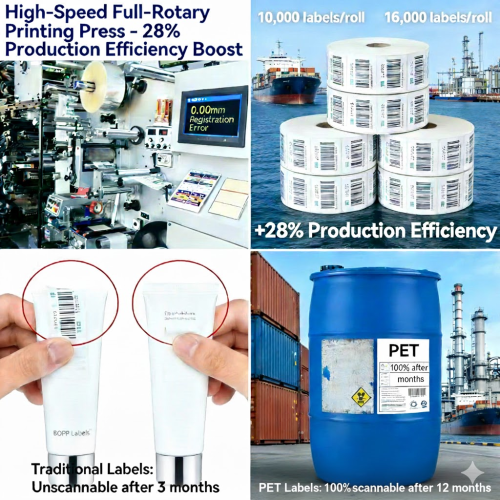
Traditional paper labels are composed of cellulose fibers derived from wood pulp. While cost-effective, cellulose is inherently hydrophilic (water-absorbing) and prone to tearing along the fiber grain. In contrast, synthetic paper labels are engineered from high-performance thermoplastic resins—primarily BOPP (Biaxially Oriented Polypropylene), PE (Polyethylene), and PET (Polyester).
Engineering durable polymer bases for high-performance labels.
The Crucial Role of Dimensional Stability
For a manufacturer, the switch to synthetic isn’t just about water resistance; it’s about Dimensional Stability.
Case Study: Solving Registration Errors in Beverage Production Last year, a European food and beverage client approached us with a critical issue: their 8-color rotary letterpress production of paper-based beverage labels was producing a 0.3mm registration error after 10,000 units, leading to 15% label waste and delayed shipments.
We recommended switching to BOPP synthetic label stock for full rotary letterpress printing. The result? A near-elimination of registration errors—even at the 50,000th label, the color alignment matched the first perfectly. Synthetic materials possess a high tensile modulus that resists stretching under the high-speed tension of rotary presses, a game-changer for high-volume synthetic adhesive label production for FMCG brands.
1.2 BOPP (Biaxially Oriented Polypropylene): The Workhorse of Modern Packaging
BOPP is the most widely used synthetic substrate in the labeling industry, and for good reason. The “Biaxially Oriented” process involves stretching the film in both the machine direction and the across-machine direction.
Technical Advantages
-
Exceptional Clarity: Provides a “no-label” look for clear glass or plastic containers.
-
High Stiffness: Ideal for high-speed automatic dispensing without curling or jams.
-
Superior Moisture Barrier: Protects both the ink and the adhesive integrity in humid environments.
Manufacturer’s ROI: A Real-World Example
A leading North American personal care brand partnered with us for their custom BOPP self-adhesive label printing for shampoo bottles.
-
The Solution: We implemented a 25-micron BOPP film, 30% thinner than their previous paper stock but equally durable.
-
The Result: This allowed 40% more labels per roll (increasing from 10,000 to 14,000 labels/roll). This change cut downtime on their automatic labeling lines by 28% and boosted hourly production output by 22%.
For high-volume full rotary BOPP self-adhesive label printing projects, this efficiency gain directly translates to lower per-unit costs and faster time-to-market.
1.3 PE (Polyethylene): The Solution for “Squeezable” Applications
While BOPP is stiff, PE is characterized by its “Ductility” (flexibility). This is the go-to material for the cosmetic and personal care industries.
The Conformability Factor: A Cosmetics Success Story
A French luxury skincare brand faced a problem with their stiff BOPP labels on squeezable lotion tubes—30% of labels developed edge lifting (“winging”) or permanent creases after consumer use.
We switched them to PE self-adhesive labels for squeezable plastic containers, and the issue vanished. PE labels have “memory,” allowing them to expand and contract with the tube as it’s squeezed, maintaining a smooth, professional finish. This is why PE is the gold standard for custom PE label printing for cosmetic squeeze tubes and personal care packaging worldwide.
Overcoming Surface Energy: Our In-Line Solution
PE has a lower surface energy than paper, which can make ink adhesion tricky. At ZR Labels, we tackle this with in-line corona treatment for PE label printing on rotary presses—a temporary electrical discharge that “roughens” the PE surface at a molecular level.
Performance Note: For a South American hair care client, this process ensured UV inks anchored deeply to their PE labels, withstanding 50+ rub tests and 6 months of exposure to shower humidity—critical for waterproof PE adhesive labels for bathroom products.
1.4 PET (Polyester): The Industrial Shield
When your labels face extreme heat, chemical splashes, or heavy abrasion, PET (Polyester) is the engineered choice. It boasts the highest melting point and chemical resistance among common synthetics.
Durability in Logistics: A Manufacturing Client Case
A German industrial equipment manufacturer needed labels for their hydraulic fluid containers that could withstand:
-
Chemical exposure during the filling process.
-
Long-haul sea freight (6-week transatlantic shipment).
-
Rough handling in industrial warehouses.
We produced PET industrial adhesive labels for chemical containers, which resisted scuffing throughout the journey. 100% of the barcodes and safety warnings remained scannable and legible upon arrival. For high-temperature resistant PET self-adhesive labels for industrial packaging, PET’s durability eliminates the need for costly reprints and ensures compliance with global safety standards.
Section 2: Industry-Specific Synthetic Label Solutions
Synthetic label substrates bring unrivaled versatility, tailored to solve distinct pain points across core manufacturing sectors. Below, we walk through how we combine hands-on material expertise with precision printing know-how to address the unique challenges of each industry vertical.
Solving unique challenges across multiple manufacturing sectors.
2.1 Food & Beverage: Uncompromising Integrity in Extreme Cold Chain
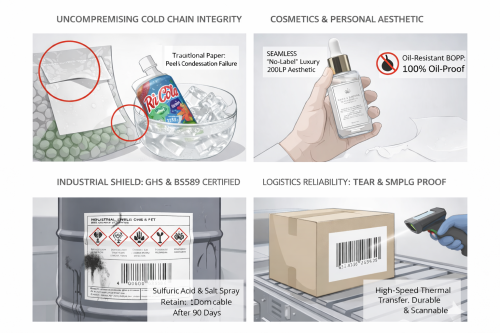
Food and beverage labels face brutal stress across the cold chain—from blast-freezing warehouses to steamy retail display cases. Traditional paper labels fail fast: condensation weakens adhesive bonds, causing peeling, curling, and illegible branding.
-
Our Solutions: Waterproof synthetic labels for frozen food packaging and condensation-resistant BOPP labels for beverage bottling lines.
Case Study: Solving the Costly Condensation Crisis
High-volume beverage producers often grapple with “Label Creep”—where condensation causes labels to slide or peel mid-process. We recently partnered with a Southeast Asian craft soda maker losing 8% of production run to this problem during pasteurization.
-
Our Technical Fix: Swapped standard paper for a food-grade BOPP substrate paired with a high-tack emulsion acrylic adhesive, calibrated for rapid temperature fluctuations.
-
The Measurable Outcome: 100% adhesion even after 72 hours submerged in ice baths. For wholesale food-grade synthetic labels, stable adhesion through thermal swings is a requirement we build into every solution.
2.2 Cosmetics & Personal Care: The Seamless “No-Label” Luxury Aesthetic
Luxury cosmetic brands demand labels that blend into packaging, creating a sleek, high-end look. This is where ultra-clear BOPP labels for glass serum bottles and precision full rotary letterpress printing make all the difference.
High-Speed Precision for Premium Skincare OEMs
A top skincare OEM required 200,000 units of “invisible” labels but faced “Silvering”—tiny air bubbles trapped under labels that ruin the premium finish.
-
Our Targeted Solution: We leveraged full rotary letterpress with a specialized UV-cured varnish, fine-tuning surface tension to enable perfect “wet-out” during automatic application, leaving a bubble-free bond.
-
Key Advantage: Premium oil-resistant synthetic stickers for cosmetic packaging that stay crystal clear, even when in contact with facial oils. No clouding, no peeling—just a flawless finish.
2.3 Industrial & Chemical: GHS Compliance and Long-Lasting Safety
Industrial labels are legal documents. Chemical-resistant synthetic tags for industrial drums and GHS-compliant PET labels for hazardous chemical packaging must remain legible for the entire product lifespan, resisting UV light and corrosive contact.
Meeting the Rigorous BS5609 Marine Immersion Standard
We worked with a Middle Eastern chemical manufacturer to develop PET labels for overseas sea freight.
-
Our Engineering Approach: We used carbon-based UV inks that chemically bond to the PET film, creating a permanent, scratch-proof layer.
-
The Hard-Won Result: Labels stood up to accidental sulfuric acid spills and stayed 100% scannable after 90 days of high-intensity salt spray. Investing in our industrial-grade PET adhesive labels means investing in compliance and liability protection.
2.4 Logistics & Tracking: Reliable Scanning for Global Supply Chains
In 3PL and global logistics, a single unreadable barcode can derail a supply chain. Tear-proof synthetic paper for logistics tracking labels ensures critical data stays intact from the factory floor to final delivery.
Built to Survive the Hustle of Logistics Operations
-
Industry-Leading Tensile Strength: Unlike paper, our synthetic logistics tags boast high tear resistance—they won’t snag on conveyor belts or tear during rough palletizing and handling.
-
Thermal Transfer Compatibility: Seamlessly works with high-speed overprinting. Shipping addresses and batch codes stay crisp and smudge-free, making them ideal heavy-duty synthetic tracking labels for 3PL and freight forwarding.
Section 3: Mastering the Craft: Rotary Letterpress vs. PS Plate Printing
Choosing the right material is only half the battle. For a manufacturer, the printing technology you select directly determines the final color consistency, registration accuracy, and cost-efficiency of your high-volume runs. At ZR Labels, we specialize in two primary high-end technologies to ensure your custom synthetic adhesive labels come out flawless, every single time.
High-speed printing technologies for superior color consistency.
3.1 Full Rotary Letterpress: The King of Consistency for FMCG Labels
When it comes to high-volume BOPP sticker label production for fast-moving consumer goods, our full rotary letterpress is the industry gold standard. Its continuous motion enables lightning-fast speeds without compromising on fine print details—a non-negotiable for FMCG brands needing consistent shelf appeal.
The “Solid Color” Advantage for Brand-Critical Labels
A top frustration for brands is “ghosting” or uneven ink density on large solid-color backgrounds, which can make products look unprofessional on supermarket shelves.
-
The Technical Solution: Our rotary letterpress features a short-ink-path system that guarantees a constant, heavy ink laydown. This eliminates streaks, light spots, and color variations across millions of units.
-
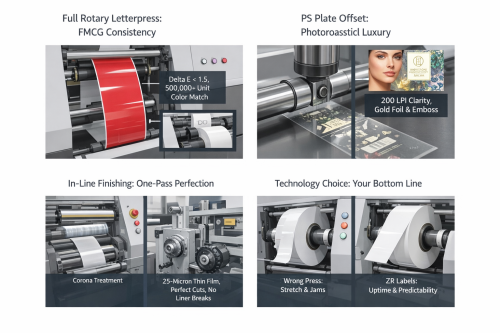
Case Study: High-Volume Beverage Labels: For a national carbonated beverage brand, we delivered 500,000 BOPP labels with a Delta E (color deviation) of less than 1.5. This ensures every bottle on the shelf looks identical, reinforcing brand recognition and consumer trust.
Looking for wholesale rotary printed FMCG labels? This unbeatable consistency is your biggest competitive edge.
3.2 PS Plate Offset Printing: Photorealistic Detail for Premium Brands
For labels demanding complex gradients, micro-text, or high-definition imagery—staples of the cosmetic, luxury wine, and skincare industries—we deploy high-precision PS Plate (Pre-sensitized) Offset presses.
Achieving 200 LPI Clarity for Luxury Finishes
While standard printing often caps out at 133 or 150 LPI (lines per inch), our PS plate technology comfortably reaches 200 LPI.
-
Why 200 LPI Matters: This ultra-fine resolution delivers smooth skin tones for cosmetic labels, sharp metallic text for wine labels, and lifelike imagery on custom PET and PE labels.
-
Case Study: Luxury Perfume Label Upgrade: We transitioned a European luxury perfume house from digital labels to PS plate offset. We sharpened their intricate gold foil detailing and cut their per-unit cost by 35% on batches exceeding 50,000 units.
3.3 In-Line Finishing: One Pass, Total Perfection
Efficiency in label manufacturing is about minimizing handling. Our presses are fully integrated “all-in-one” workstations that handle printing, treating, and finishing in a single seamless pass.
Our Integrated In-Line Capabilities:
-
In-Line Corona Treatment: We prep PE and BOPP surfaces during printing to ensure permanent ink anchorage that resists scratching and fading—critical for refrigeration or outdoor displays.
-
Anti-Counterfeit Integration: Apply tactile textures, raised embossing, or holographic cold foils in one pass for pharmaceuticals and high-value electronics, cutting lead times by up to 40%.
-
Precision Magnetic Die-Cutting: Ensures even the thinnest 25-micron PET and PE films are cut perfectly without piercing the liner. This prevents “label breaks” on your automatic dispensing lines, reducing downtime and waste.
3.4 Why Technology Choice Impacts Your Bottom Line
Many brokers or small shops rely on flatbed or semi-rotary presses. While cheaper for short runs, they lack the precise tension control required for synthetic films like BOPP, PET, and PE.
Manufacturer’s Critical Note: Using the wrong press for a 100,000-unit order is a costly mistake. Inadequate tension control leads to material stretching, resulting in labels that are “out of spec” for your automatic labeling machines. This causes jams and production downtime.
At ZR Labels, our investment in full rotary and PS plate technology is an investment in your production uptime, cost predictability, and brand reputation.
Section 4: Quality Control and Global Compliance: Protecting Your Brand at Scale
In high-volume manufacturing, a label is a mission-critical component of your packaging line. A single flaw—be it a non-scannable barcode or adhesive bleeding—can halt production, costing thousands in downtime. At ZR Labels, our quality management system roots out these risks before a single roll leaves our facility.
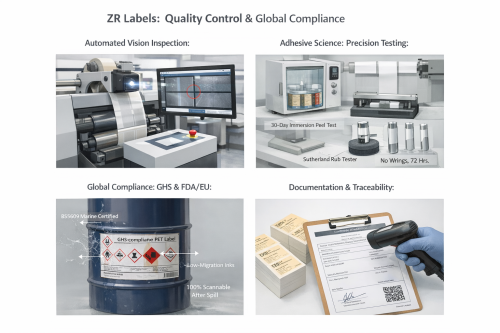
Ensuring zero-defect manufacturing through rigorous laboratory testing.
4.1 Automated Vision Inspection: Zero-Defect Manufacturing
Many suppliers rely on manual spot-checks, which leave room for human error. We integrate high-speed automated vision inspection systems directly into our rewinding lines for a 100% quality check.
Why 100% Inspection Matters for Your ROI
On a run of 1,000,000 wholesale FMCG BOPP adhesive labels, even a 1% error rate means 10,000 defective units that can jam your applicators.
-
The Technology: High-resolution cameras scan every label at 150 meters per minute, cross-referencing against your approved “Golden Copy” master.
-
The Result: Our system instantly flags defects like ink splashes, missing barcodes, or “hickies” (ink spots). You receive 100% compliant rolls, ensuring jam-free performance on your high-speed automatic labeling lines.
4.2 Adhesive Science: Precision Testing for Real-World Use
Adhesive must be calibrated to the surface energy of your container. A bond that works on glass may fail on recycled HDPE plastic.
Our Laboratory Testing Protocol:
Before any bulk synthetic label production, we conduct rigorous application-specific tests:
-
90-Degree Peel Test: Measures bonding force to ensure permanent adhesion for long-shelf-life goods or residue-free removal for reusable containers.
-
Sutherland Rub Test: Simulates transit friction. For our industrial PET labels, we guarantee ink integrity even after 100+ high-pressure rub strokes.
-
Mandrel Testing: We wrap labels around small-diameter cylinders (like lip balm or vials) for 72 hours to ensure zero “winging” or edge lifting, even on tight curves.
4.3 Global Compliance: Meeting GHS, FDA, and REACH Standards
We ensure your labels aren’t just durable—they are fully compliant with international regulations, preventing customs delays or costly recalls.
Compliance by Category:
-
Food Safety (FDA/EU): We use low-migration inks and FDA-compliant adhesives for our synthetic food-grade BOPP labels, ensuring no harmful chemicals leach into your products.
-
GHS & Chemical Safety: Our labels meet BS5609 Section 3 certification for marine immersion. We ensure hazard symbols and precautionary statements meet exact size and color specs for GHS-compliant chemical label printing.
-
Sustainability (REACH/RoHS): We offer labels free of restricted substances, helping you meet CSR goals and enter markets with strict environmental rules.
4.4 Documentation and Traceability: High-Stakes Accountability
For pharmaceutical and high-end FMCG clients, traceability is a regulatory mandate. Every shipment includes a detailed Certificate of Analysis (COA).
Batch Tracking for Peace of Mind:
-
Detailed Records: We log raw material lot numbers, ink batches, and production line IDs for every order.
-
The Benefit: If an issue arises in the field, we can perform a root-cause analysis within minutes. This level of accountability makes us the preferred label supplier for pharmaceutical printing and batch-certified FMCG stickers.
Section 5: Global Logistics and Supply Chain Excellence
For manufacturers, label quality is only half the guarantee of a successful partnership. The other half is ensuring labels are delivered to your production line on time and in perfect condition. At ZR Labels, we uphold the same rigorous standards for supply chain logistics as we do for printing quality control.
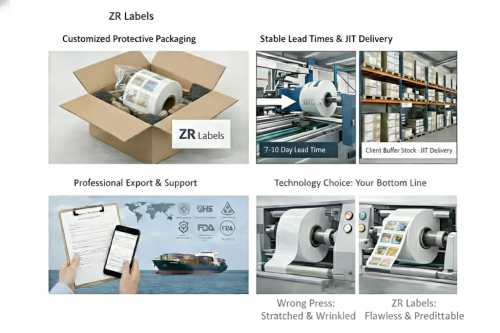
Reliable international delivery and JIT supply management.
5.1 Customized Protective Packaging for Global Shipping
Synthetic labels—especially ultra-thin BOPP and PE film labels—are highly sensitive to temperature, humidity, and pressure. Improper packaging can cause “roll telescoping” or crushed cores, rendering automatic applicators useless.
-
Moisture-Proof Sealing Process: Each roll is shrink-wrapped with a built-in desiccant. This prevents moisture intrusion during long-haul sea freight from affecting adhesive viscosity.
-
Export-Grade Heavy-Duty Corrugation: We use double-walled export-specific cartons with internal partition pads to eliminate edge collisions and damage during transit.
-
Standardized Palletizing Solutions: For synthetic label wholesale orders, we utilize heat-treated pallets reinforced with edge protectors. This ensures labels remain intact from humid tropical ports to cold inland warehouses.
5.2 Stable Lead Times Aligned with Your Production Rhythm
We understand that your factory operates on a fixed schedule. A two-day delay in label delivery can lead to a full week of costly downtime.
-
7-10 Day Lead Times: Leveraging the high-efficiency output of our full rotary and PS plate offset presses, we offer a standard lead time of 7-10 working days for bulk orders, helping you accelerate your production cycles.
-
Inventory Buffer Program: For long-term FMCG and industrial partners, we offer tailored Stock Management Solutions. We can maintain a 3-month buffer of your custom labels in our climate-controlled warehouse, supporting Just-In-Time (JIT) delivery to keep your lines running without overstocking your on-site facility.
5.3 Professional Export & Support Services
Navigating international customs can be a supply chain bottleneck. As an experienced global label exporter, we simplify the entire process for you.
-
Comprehensive Documentation: We provide all necessary export documents, including Certificates of Analysis (COAs), Packing Lists, and Commercial Invoices, all customized to meet your local customs requirements.
-
Flexible Shipping Terms: Whether you require FOB, CIF, or DDP (Delivered Duty Paid), we partner with leading global freight forwarders to ensure door-to-door delivery with no hidden costs or unexpected delays.
Conclusion: Partner with a Synthetic Label Specialist
Choosing the right adhesive synthetic labels is a balancing act of polymer material science, printing engineering expertise, and supply chain reliability. From the initial selection of BOPP, PE, or PET raw materials to the final automated quality inspection, ZR Labels is committed to enhancing your brand’s shelf appeal and production efficiency.
Manufacturer’s Advice: Don’t let a “low-cost” label turn into a costly production failure. Partner with a manufacturer that truly understands the technical demands of high-volume international label supply.
Ready to Optimize Your Labeling Process?
 English