The Chill Factor: How to Choose Food Labels That Survive Freezer & Fridge
16 December, 2025Cómo elegir etiquetas adhesivas para su nueva línea de producción
20 January, 2026Published on January 19, 2026 | by ZR Labels
When setting up a new production line—whether for food & beverage, cosmetics, or electronics—selecting the right adhesive labels is a critical decision that often impacts operational efficiency and product compliance. Many new manufacturing facilities encounter avoidable challenges due to inadequate label planning: frequent jams in automatic labeling machines, adhesive failure in varying storage conditions, inconsistent print quality during high-volume runs, or difficulty aligning quality with budget constraints for bulk orders.
New bottling plants and contract manufacturers typically face consistent pain points with label procurement:
-
Labels that snag, tear, or misfeed in high-speed labeling equipment.
-
Adhesives unable to withstand extreme temperatures, humidity, or product contact (oils/acids).
-
Print inconsistency when scaling production to large batch sizes.
-
Balancing durable, compliant labeling with cost-effective bulk pricing.
This guide outlines the key considerations for choosing labels tailored to new production lines—and why an increasing number of new facilities are partnering with China-based suppliers like ZR Labels to address these challenges.
1. Prioritize Compatibility with Your Labeling Machine
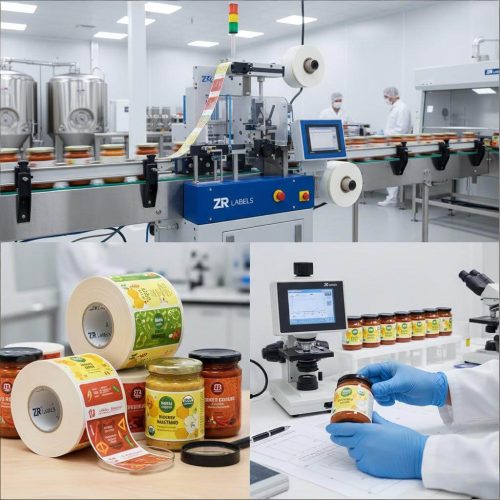
Durable labels engineered for food, cosmetics, and electronics.
Your automatic labeling machine serves as the cornerstone of efficient packaging operations; labels must be engineered to integrate seamlessly with its specifications to minimize downtime.
-
Dimensions and Form Factor: Adhere to the machine’s recommended label size and shape parameters. Non-standard or ill-fitted labels are a primary cause of jams. We ensure precision die-cutting with a tolerance within ±0.5mm to prevent sensor misreads.
-
Liner Quality & Release Force: A smooth, robust liner is essential for consistent feeding. For high-speed lines (over 300 BPM), we recommend PET-30 or high-density Glassine liners. We calibrate the Release Force (the effort required to peel the label from the liner) to ensure it is neither too tight (causing tears) nor too loose (causing premature dispensing).
-
Adhesive Formulation (Initial Tack vs. Ultimate Adhesion): For fast-moving lines, high Initial Tack is required for the label to grab the container instantly upon contact. Ultimate Adhesion develops over 24 hours to ensure long-term bonding. Subpar adhesive quality often leads to “flagging” (edge lifting), compromising product presentation.
-
Winding Direction (Positions 1-8): To avoid “Labels In” vs. “Labels Out” errors, we strictly follow international Unwind Direction charts. Correct orientation (Head-first, Foot-first, etc.) is verified against your applicator’s sensor position to ensure “plug-and-play” readiness.
Pro Tip: For new labeling equipment—including leading brands such as Krones, Sidel, and Avery Dennison—share detailed technical specifications with your label supplier. At ZR Labels, we conduct pre-shipment testing to validate roll tension and eliminate “telescoping” issues.
2. Select Materials Aligned with Functional Environments
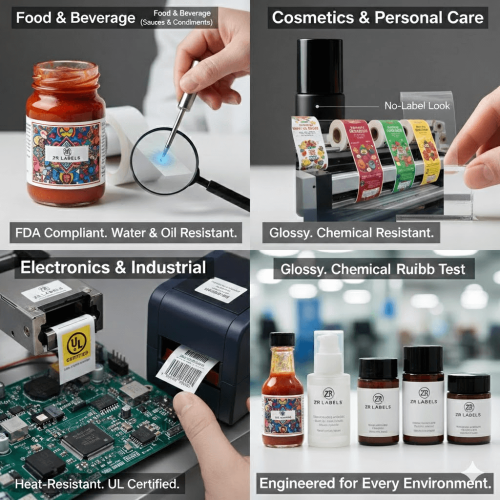
Rigorous 100% quality inspection ensures zero-defect production.
Labels must endure the full product lifecycle. Material selection should be guided by industry-specific needs and Surface Energy considerations:
-
Food & Beverage (Sauces & Condiments): BOPP, PE, or food-grade paper are preferred. We perform Corona Treatment on filmic substrates to increase ink anchorage. These materials offer water and oil resistance, withstand condensation, and meet FDA/EC 1935/2004 compliance standards—mandatory for global market access.
-
Mandrel Performance for Small Diameters: If you are labeling small sauce bottles or vials, we use materials with high Conformability to prevent the “memory effect” where the label attempts to straighten and pops off the curved surface.
-
Cosmetics & Personal Care: Manufacturers often opt for PET or PP. These materials resist degradation from fragrances and lotions. We use UV-Varnish tested via the Sutherland Rub Test to ensure graphics remain scannable even after contact with chemical components.
-
Electronics & Industrial: In sectors with thermal output, we provide Polyimide or thermal paper with high heat resistance and UL certification for safety compliance.
Critical Note: For facilities exporting to the EU or U.S., compliance with REACH (EU) and FDA food contact (U.S.) standards is non-negotiable. ZR Labels provides full certification documentation (COA/TDS) upfront to streamline your quality audit.
3. Optimize Cost Efficiency for Bulk Orders Without Compromising Quality
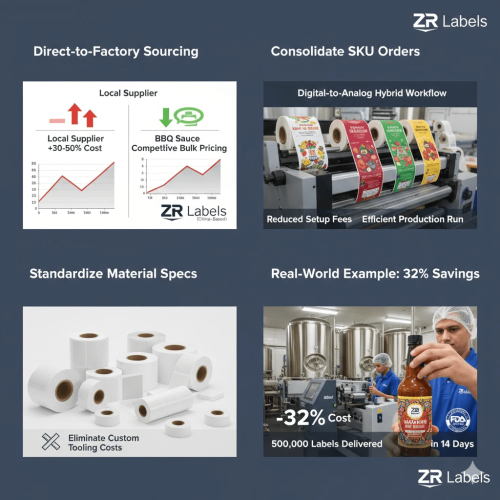
Direct-to-factory sourcing saves up to 32% on costs.
New production lines operate within tight budget parameters. Here are actionable strategies to control costs:
-
Direct-to-Factory Sourcing: Local suppliers often apply a 30–50% markup. China-based manufacturers like ZR Labels leverage economies of scale for high-volume runs (100,000+ labels). For example, a new craft brewery in the Philippines reduced label costs by 32% by switching to our bulk manufacturing model.
-
Consolidate SKU Orders: Combining multiple product labels (e.g., different sauce flavors) into a single production run using Digital-to-Analog hybrid workflows reduces setup fees—a significant cost driver.
-
Standardize Material Specs: Utilizing standard-gauge films and common die-shapes eliminates custom tooling costs while maintaining high durability.
Real-World Example: A startup condiment packer approached ZR Labels after facing prohibitive pricing from local vendors. They required 500,000 labels for a Hot-Fill sauce line. We provided a high-tack, heat-resistant adhesive that survived the thermal shock of the filling process, matched their Sidel machine specs, and delivered at 32% below the local quote.
4. Choose a Supplier Equipped to Support New Production Lines
Launching a new line demands a supplier that offers technical depth, not just a catalog. Key criteria include:
-
Lead Time Efficiency: Timely delivery is critical. We offer 7–14 day mass production and 48-hour rapid prototyping for new facilities.
-
Technical Support & Troubleshooting: Access to responsive expertise is essential for troubleshooting misfeeds or adhesion failure. Our team provides direct access to engineers specializing in Label-Machine Integration.
-
Free Prototyping for Line Testing: Reputable suppliers provide complimentary samples to test Die-cut precision, Ink rub resistance, and machine compatibility before finalizing bulk orders.
Conclusion
Selecting adhesive labels for a new production line requires a strategic approach that balances machine compatibility, thermodynamic stability, and cost efficiency. By focusing on technical specifications like Release Force and Surface Anchorage, and partnering with a supplier that understands the unique needs of automated facilities, you can eliminate operational disruptions.
Ready to streamline your label procurement process? We’re here to eliminate the guesswork.
Email your label specifications and machine details to info@zrlabels.com, and our technical team will respond within 24 hours with personalized recommendations.

 English