Beyond Compliance: 5 Ways Smart Food Labels Drive Sales and Build Trust
12 December, 2025How to Choose Adhesive Labels for Your New Production Line
19 January, 2026For food brands, nothing looks less professional than a product with a peeling, curling, or saturated label. This failure is most common when packaging faces the triple threat: moisture, refrigeration, and deep freezing.
If your custom food adhesive labels are designed for the pantry, they will certainly fail in the freezer. The cold not only challenges the material but, critically, destroys the adhesive bond.
This guide reveals the essential material science behind durable refrigerated food labels and freezer food labels, ensuring your brand presentation remains perfect from your facility to the consumer’s kitchen.
1. The Science of Failure: Why Do Labels Curl and Peel?
Label failure in cold environments is fundamentally a problem of physics: the interaction between the packaging surface, the adhesive, and the label material itself.
A. The Low-Temperature Challenge (The Adhesive)
-
Most standard, general-purpose adhesives harden and lose tackiness below room temperature.
-
When applied in a cold environment, the bond never fully forms.
-
When a frozen product thaws, the label surface rapidly cools, causing severe label curl.
B. The Moisture Challenge (The Material)
-
Paper labels absorb condensation (dew point moisture) rapidly.
-
This absorption causes the paper fibers to swell and warp, leading to bubbling and peeling.
-
In cold storage, even small amounts of condensation can saturate a non-waterproof label, blurring ink and damaging the visual presentation.
2. Choosing the Right Adhesive: The Cold Storage Warriors
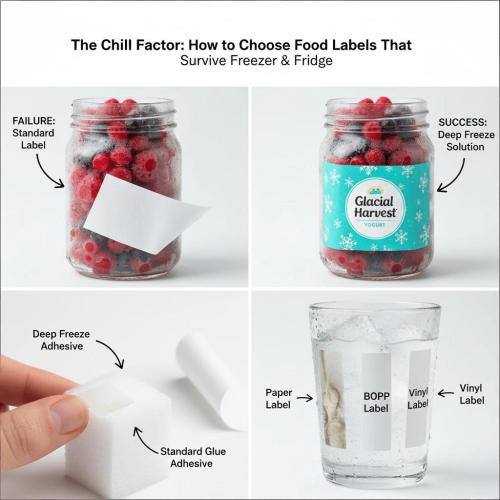
Comparison of standard labels vs deep freeze solutions for cold storage.
The adhesive is the single most important component for durable freezer food labels. You need specific formulations designed to work below freezing.
| Adhesive Type | Ideal Use Case | Key Benefit |
| Deep Freeze Adhesives | Frozen meats, ice cream, foods stored below 0°C. | Maintains strong tack even at temperatures as low as -40°C. |
| Chill/Refrigeration Adhesives | Dairy, pre-made meals, beverages stored between 0°C and 10°C. | Excellent initial tack on cold, damp surfaces; resists condensation. |
| Moisture-Resistant Permanent | Jars, bottles susceptible to condensation or wipe-down cleaning. | Prevents adhesive breakdown when exposed to water or high humidity. |
Expert Tip: Ensure your labels are applied at the correct temperature—ideally room temperature—before they are subjected to refrigeration. Applying a label onto an already cold, wet surface is a recipe for failure.
3. Choosing the Right Material: Waterproof is Non-Negotiable
Once the adhesive is secure, the label material must resist the water and ice that define cold storage. This usually means moving away from standard paper.
Top Materials for Cold Environments:
-
BOPP (Biaxially-Oriented Polypropylene):
-
The King of Cold: Extremely durable, tear-resistant, and completely waterproof.
-
Ideal For: Products frequently handled or stored in high humidity/wet environments, like bottled drinks or refrigerated food labels.
-
-
Vinyl:
-
Highly Flexible: Can conform well to contoured packaging (e.g., squeeze bottles, irregular shaped containers).
-
Feature: Exceptional moisture resistance and longevity.
-
-
Synthetic Paper (Polyart/Polypropylene Blends):
-
Offers the smooth look of paper but with the high durability and water resistance of plastic.
-
Good For: Brands wanting a natural paper aesthetic without the peeling risk.
-
If your product will be submerged in ice water (e.g., drinks), or subjected to rapid temperature changes (e.g., from freezer to microwave), a waterproof food label made from BOPP is essential.
4. Case Study: Solving the “Frozen Smoothie” Problem
A client who sold high-end frozen smoothies faced a critical problem: their labels looked perfect when applied, but after two weeks in the freezer, they were peeling and had ice crystals beneath them.
The Solution:
-
Initial: They were using semi-gloss paper with a general permanent adhesive.
-
Upgrade: We switched them to a Deep Freeze Adhesive paired with a White Gloss BOPP material.
-
Result: The BOPP resisted the extreme cold and condensation, and the specialized adhesive maintained its bond at $-25^\circ \text{C}$, completely eliminating the peel and curl problem.
This highlights that durability is not just about material, but the perfect synergy between material, adhesive, and application.
Conclusion: Invest in Cold-Proof Quality
In the competitive food market, your packaging is your promise of quality. Allowing cheap labels to fail in the refrigerator or freezer is a massive blow to your brand’s perception.
Choosing the right freezer food labels requires expertise in material science and adhesive technology—the kind of expertise that prevents costly recalls and ensures your product looks as good as it tastes.
Don’t let the Chill Factor compromise your brand.
Ready to select the perfect cold-proof label? Visit our main guide for detailed material specifications and expert consultation on durable Custom Food Adhesive Labels that are engineered to survive any environment.

 English